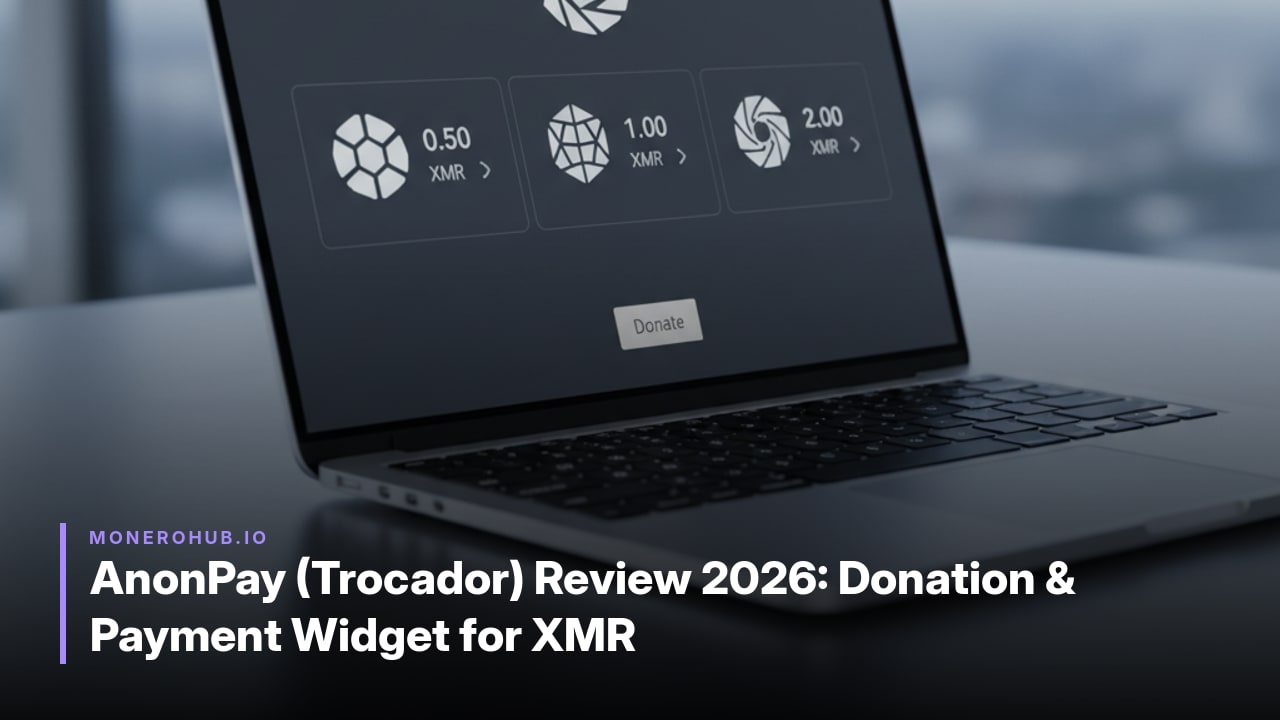
AnonPay by Trocador lets merchants and creators accept over 1,000 coins while receiving XMR directly. This 2026 review covers features, privacy trade-offs, fees, and integration options.
AnonPay functions as a non-custodial gateway that routes payments through partner exchanges and swaps. Recipients choose their preferred coin, such as Monero, and receive it directly in their personal wallet without the service ever taking custody of the funds.
The widget supports over 1,000 cryptocurrencies. Payers can send any supported asset while the merchant or donor always obtains exactly the coin they selected. This direct receipt removes the need to manage or immediately convert unwanted tokens.
Transactions carry a limit of 5 BTC equivalent. Trocador charges zero extra aggregator fees on AnonPay usage; only partner spreads apply, and these drop to zero when the incoming coin matches the recipient's choice exactly.
The setup gives Monero-focused recipients broad acceptance options while they retain full control of their keys and avoid holding volatile assets.
AnonPay supports two primary flows for receiving XMR. The direct widget embeds on a site so payers interact with a hosted interface that handles the swap. The indirect method uses the API to generate a transaction ID first, then displays a payment address or QR to the sender without further widget involvement.
Fixed-rate quotes lock the exchange rate at creation for either flow. Webhooks and email alerts notify the recipient when a transaction reaches the chosen confirmation threshold. A dedicated BTCPay Server plugin integrates the same routing logic directly into existing stores.
JavaScript is fully optional; the widget can render without it for Tor users. Interface colors, button text, and donation versus fixed-amount modes are all customizable. Fiat amounts display via CoinPaprika rates even though no fiat is accepted. Indirect transactions expire after 72 hours if unpaid.
Partner exchange spreads apply on conversion routes while Trocador adds no extra aggregator fee. Limits remain partner-dependent up to the 5 BTC equivalent cap per transaction.
AnonPay imposes no account creation or KYC at the Trocador layer. Users interact with the widget or API and the chosen cryptocurrency settles directly into the recipient’s wallet. Any identity checks originate solely from the selected swap partner.
Trocador routes support Tor and onion access for the widget, documentation, and API calls. This reduces IP leakage when the payer loads the payment page or when the recipient configures webhooks.
Privacy stops at the partner boundary. If the chosen route passes through an exchange that applies AML screening, the payer’s details can be collected before the swap executes. The service does not mask the payer from that partner or prevent the partner from logging the transaction.
AnonPay conceals the direct payer-to-recipient relationship at the aggregator level, yet it cannot hide on-chain flows after the swap completes. A Monero recipient receives standard XMR; any prior history of that output remains visible to chain analysis. Clearnet use of the widget exposes the payer’s IP to Trocador servers unless Tor is active. Fiat on-ramps through partners introduce separate KYC points that Trocador does not control.
Recipients should generate addresses on their own node and avoid address reuse. Payers should always access the widget over Tor and review the privacy policy and KYC triggers of the specific partner before confirming a route. The 5 BTC-equivalent limit applies uniformly, but KYC thresholds below that limit are set by each partner.
AnonPay differentiates itself from other Monero-friendly donation and checkout tools through its documented non-custodial structure and fee transparency. Official sources state that Trocador applies zero extra aggregator fees on AnonPay transactions, with only partner spreads applying; some 2026 reviews note an affiliate cut of 0.1–0.35 percent baked into displayed rates.
| Criteria | AnonPay (Trocador) | Alternative Widgets |
|---|---|---|
| Fees | Zero extra aggregator fees (partner spreads only) | Vary by provider |
| Privacy model | Non-custodial, no Trocador KYC or account required, Tor/onion support | Provider-dependent |
| Integration effort | BTCPay Server plugin, API/JSON, widget with optional JavaScript | Vary by tool |
| Settlement time | 5–30 minutes on tested routes | Vary by route |
| Limits | Equivalent of 5 BTC per transaction | Provider-dependent |
Indirect-method transactions expire after 72 hours if unpaid. Because the briefing supplies no verified 2026 figures for specific competitors, direct numerical head-to-heads remain limited to AnonPay’s documented parameters.
Merchants begin by choosing between direct widget embedding and the indirect API route on the Trocador dashboard. For the widget, customize colors, button text and mode before copying the generated code into the site HTML.
Optional JavaScript-free fallback ensures Tor users can still complete payments without exposing additional browser data.
Trocador charges zero extra aggregator fees on AnonPay transactions. Only partner exchange spreads apply, and these drop to zero when the payer’s coin matches the recipient’s chosen coin exactly.
No account or KYC is required at the Trocador layer. Any KYC or AML checks are triggered only by the selected partner exchange on the payer side.
The service supports over 1,000 cryptocurrencies, allowing payers to send any supported coin while the recipient receives the chosen coin such as XMR directly in their wallet.
Settlement on tested routes completes in 5–30 minutes according to 2026 reviews.
Yes, the widget and API include full Tor and onion support for both direct and indirect payment flows.
A dedicated BTCPay Server plugin is available, enabling merchants to accept altcoins that convert to their preferred coin including XMR.
Indirect-method transactions expire after 72 hours if left unpaid.
Transactions are capped at the equivalent of 5 BTC.
