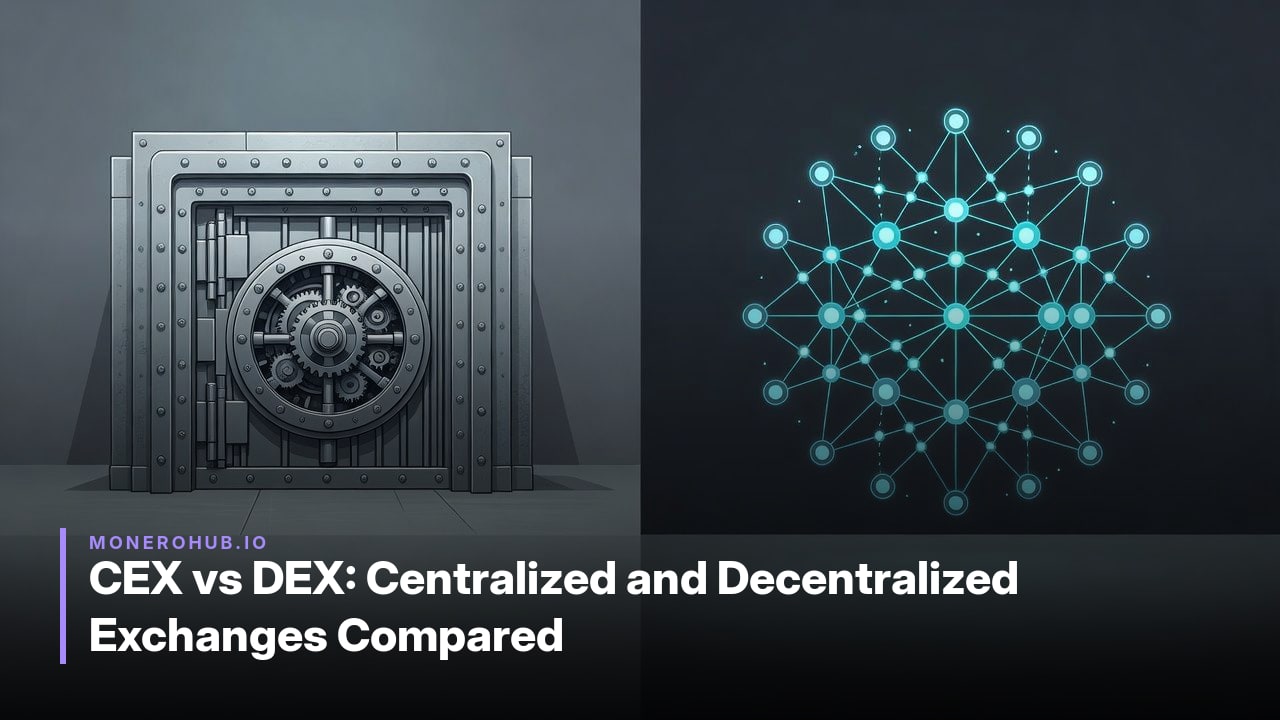
Compare CEX and DEX mechanics, 2026 volumes, fees, security and privacy trade-offs with data from CoinDesk and CoinGecko to choose the right venue.
Centralized exchanges operate as intermediaries that take custody of user assets after KYC verification. Traders deposit funds to exchange-controlled wallets, then place orders that the platform matches through an internal order book. This setup allows deep liquidity for major pairs and fast execution, but users lose direct control of private keys while assets remain on the platform.
Decentralized exchanges remove the custodian entirely. Users retain assets in their own wallets and trade either through automated market maker pools that set prices via liquidity ratios or through peer-to-peer settlement executed directly on-chain. Listings are typically permissionless, so any token can appear once smart contracts are deployed, yet every trade incurs gas fees and depends on the underlying blockchain’s throughput.
Hybrid models attempt to blend both approaches by keeping order matching off-chain while final settlement occurs on-chain. Regardless of architecture, the core distinction remains custody: CEXs hold funds on behalf of users, while DEXs require users to sign transactions from self-custodied wallets before any swap or perpetual position can settle.
July 2026 data from CoinDesk Research shows centralized exchanges still command the majority of activity. Combined CEX spot and derivatives volume reached $3.76T that month, with spot at $727B and derivatives at $3.03T. DEX spot volume stood at $176B, securing a record 19.5% share of total spot trading.
CoinGecko’s January 2026 report highlights faster relative growth on the decentralized side in perpetuals. DEX perps volume hit $739.48B with a 10.2% market share, up from 2.0% the prior year, while total perps across all venues reached $7.24T.
| Metric | CEX | DEX | Source & Date |
|---|---|---|---|
| Spot volume | $727B | $176B | CoinDesk, July 2026 |
| Spot share | 80.5% | 19.5% | CoinDesk, July 2026 |
| Derivatives volume | $3.03T | — | CoinDesk, July 2026 |
| Perps volume | — | $739.48B | CoinGecko, Jan 2026 |
| Perps share | — | 10.2% | CoinGecko, Jan 2026 |
These figures illustrate that while absolute CEX volumes remain larger, DEXs have steadily increased their slice of spot and perps markets through on-chain activity on chains such as Solana and Base.
Centralized exchanges rely on maker-taker fee schedules that reward liquidity provision within deep order books, allowing large orders to execute with limited price movement. Decentralized exchanges shift costs to on-chain gas fees plus slippage from automated market maker pools, where execution depends on available liquidity depth rather than a central matching engine.
Uniswap handled $53.4B in spot volume in July 2026 while PancakeSwap recorded $18.5B, according to CoinDesk Research. These figures illustrate concentrated liquidity in major pools, yet traders still face variable slippage on size that exceeds pool reserves, especially during volatile periods. Gas costs further compound total expenses and fluctuate with network congestion.
Order-book venues deliver predictable fills once liquidity exists, while AMM designs expose users to impermanent loss for liquidity providers and execution uncertainty tied to block times. Hybrids attempt to blend off-chain matching with on-chain settlement, but pure DEX execution remains subject to the underlying chain’s throughput and fee market.
Centralized exchanges place user funds in custodial wallets controlled by the platform, creating a single point of failure that has repeatedly led to losses during breaches or insolvencies. Traders must complete KYC verification to access these services, linking their identity to every transaction and exposing them to regulatory subpoenas or account freezes.
Decentralized exchanges remove custody by letting users retain private keys and execute trades directly from self-hosted wallets. Settlement occurs on-chain through smart contracts or automated market makers, which eliminates intermediary risk but introduces new attack surfaces. Exploits targeting flawed contract code or liquidity bridges have drained millions in assets when vulnerabilities are discovered after deployment.
Regulatory exposure also diverges sharply. CEX operators face licensing requirements, AML reporting, and potential asset seizures, while DEX protocols often operate without entity control yet remain subject to enforcement actions against front-end interfaces or token issuers. Users on DEXs must still manage wallet security and approve potentially malicious contract interactions, shifting the burden of protection entirely to the individual.
Centralized exchanges create direct identity links because KYC verification attaches verified personal data to every deposit, trade and withdrawal involving Monero addresses. Once an account is approved, exchange records can connect real-world identities to specific transaction flows even when the Monero side itself remains private.
Decentralized exchanges avoid KYC but expose wallet addresses on public ledgers. Analysts can cluster these addresses through timing, amount patterns or interaction with known services, creating indirect links that survive Monero’s ring signatures when users later bridge or cash out.
Monero-specific tools reduce some of these leaks. Wallets that generate fresh subaddresses for each counterparty limit reuse. When extra separation is required, users may route funds through network-native mixing services before or after a DEX trade. IP address correlation remains a weak point on clearnet DEX front-ends; routing all activity through Tor or I2P nodes is standard practice. No single option removes every correlation vector, so traders combine address hygiene, timing delays and network-level obfuscation rather than relying on one measure.
CoinDesk Research reported DEX spot volume of $176B that month for a record 19.5% share of total spot trading even as absolute volumes dropped.
Binance captured 45.8% of CEX derivatives volume in July while Hyperliquid entered the overall top 10 perps exchanges and helped lift DEX perps share to 14.9%.
CEXs apply maker-taker fees that may include rebates for high volume. DEXs add protocol fees to variable gas costs that fluctuate with network demand and chain used.
Traders typically select CEXs for fiat ramps, deepest liquidity on major pairs, and regulated environments when KYC is acceptable.
DEXs suit permissionless listings, direct wallet control, and avoidance of custody risks especially during high on-chain activity periods.
From January 2024 levels, DEX perps volume reached $739.48B by January 2026 according to CoinGecko data, fueled by new chains and protocols.