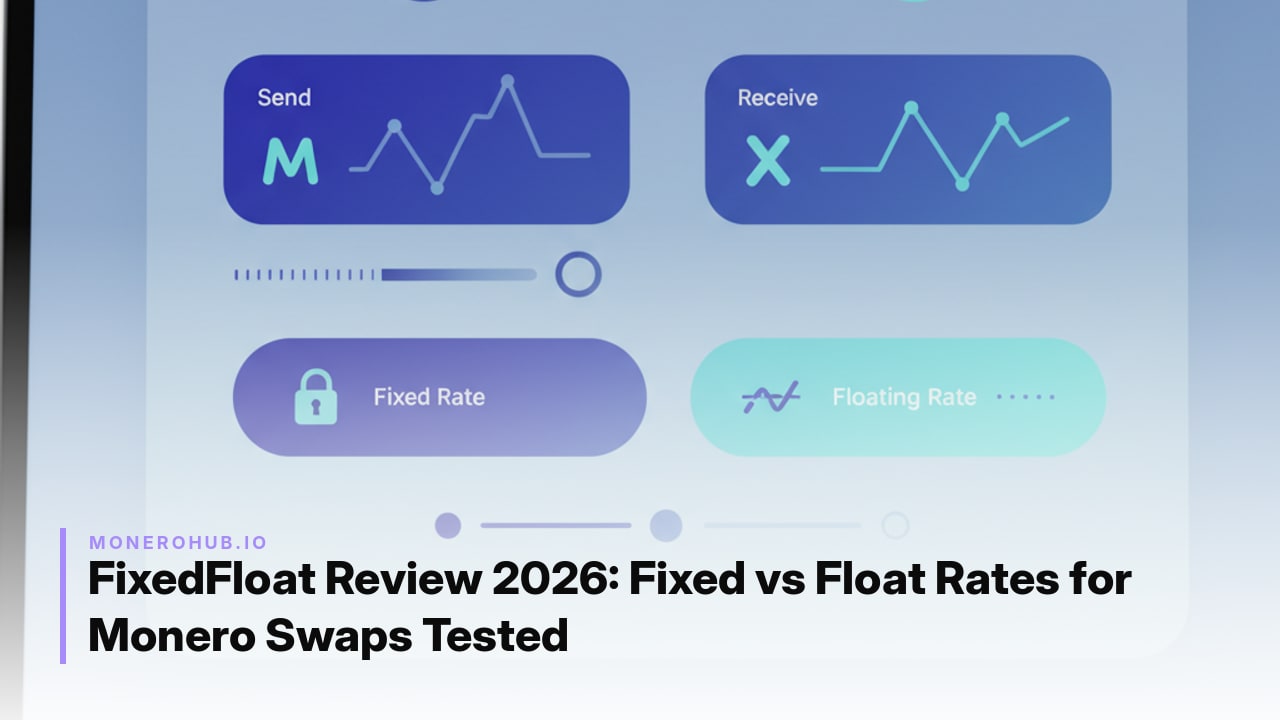
2026 review of FixedFloat for Monero swaps comparing fixed-rate and floating-rate modes, fees, lock times, security history and OPSEC steps using verified platform data.
FixedFloat operates as a non-custodial instant cryptocurrency exchange launched in 2018. It supports swaps that include Monero (XMR) pairs without mandatory KYC or registration for standard transactions.
The platform holds an Estonian FIU licence and lists more than 100 supported assets. Minimum swap size sits at roughly $1 equivalent. Users select between fixed-rate and floating-rate modes on every pair, with fees and network costs shown before deposit.
Lightning Network support applies to BTC routes. The service excludes US users and applies risk-based AML checks that may trigger verification on larger or flagged transactions. Funds transit the platform only briefly during each swap, preserving the non-custodial model described in its documentation.
FixedFloat presents both fixed-rate and floating-rate options on every supported pair, including those involving Monero. The fixed-rate mode locks the quoted exchange rate for 10 minutes from order creation and includes a 1.2 % market-move threshold that can trigger a refund or adjustment if the rate shifts beyond that limit, according to the platform’s official FAQ. The floating-rate mode instead applies the rate at the moment the required blockchain confirmations are reached, allowing the final amount received to vary with market movement.
Users see the chosen mode, the applicable fee, and the network fee displayed explicitly before any deposit address is generated. Fixed-rate selections suit swaps where rate certainty matters more than the 0.5 % higher service fee, while floating-rate selections are shown with the lower 0.5 % fee plus network costs. Both modes operate on the non-custodial model, with funds moving through the service only for the duration of the swap.
FixedFloat discloses both fee modes before any deposit. Fixed-rate swaps carry a 1 % service fee plus network fee, while floating-rate swaps carry a 0.5 % service fee plus the same network fee. The lower floating fee comes with rate uncertainty that resolves only after the required blockchain confirmations arrive.
| Feature | Fixed Rate | Floating Rate |
|---|---|---|
| Service fee | 1 % + network fee | 0.5 % + network fee |
| Rate validity | Locked for 10 minutes from order creation | Set at final confirmation |
| Market-move threshold | 1.2 % triggers possible refund or adjustment | No lock, so no threshold |
| Minimum swap | ~$1 equivalent | ~$1 equivalent |
| Monero confirmation | Rate holds during standard XMR confirmations | Rate finalised only after required XMR confirmations |
Both modes display the exact network fee at order creation. The 10-minute fixed-rate window, drawn from the official FAQ as of 2026, gives traders a clear window to fund the deposit address. If the market moves beyond the 1.2 % threshold inside that window, the platform may refund or adjust the order. Floating-rate users accept whatever rate prevails once the swap reaches the confirmation stage, which removes the time pressure but exposes them to volatility between quote and settlement.
Refund conditions differ by mode. Fixed-rate orders that time out or hit the 1.2 % threshold receive automatic handling according to the disclosed policy. Floating-rate orders simply settle at the prevailing rate once confirmations complete, with no separate refund trigger tied to rate movement. No Monero-specific confirmation count is published beyond the general requirement that the final rate waits for those confirmations.
FixedFloat suffered two major incidents in 2024. Roughly $26.1 million was stolen in February and another $2.8 million in April, for a combined total of about $28.9 million. Both attacks exploited vulnerabilities in third-party infrastructure.
The platform stayed offline for more than two months. It rebuilt its infrastructure with a migration from the compromised hosting provider, introduced automated scanning plus multi-sig elements for certain routes, and completed audits before resuming operations.
By 2026 the service ran without further major incidents. Reviews published in September 2026, including Swapzone on September 14 and Baltex on September 23, treat FixedFloat as operational yet note the breach history as a factor users should weigh for larger Monero swaps.
Acquire Monero only through non-KYC channels so that an on-ramp does not attach identity data to the coins entering the swap. Access ff.io over Tor or a no-logs VPN; the service runs on clearnet and an exposed IP can correlate the transaction even when the blockchain side remains private.
Leave the optional email field blank. Supplying an address lets the platform send order updates but creates an account-like record that survives the brief custodial window. Keep the Monero wallet seed offline and never enter it on any exchange interface; generate a fresh receiving address for each swap.
Remember that user funds sit on FixedFloat servers between deposit confirmation and payout, despite the non-custodial claim. Limit exposure by swapping only the amount needed and by choosing the fixed-rate option so the exact XMR output is known before the deposit is sent. After the swap completes, run the output through a separate wallet with its own seed before further use.
Fixed-rate swaps incur a 1% service fee plus network fees with the rate locked for 10 minutes from order creation. Floating-rate swaps use a 0.5% fee plus network fees, with the final rate determined after required confirmations.
A fixed rate protects against short-term price moves within the 10-minute window but carries the higher fee. Floating rates expose the swap to market changes until confirmations complete, potentially delivering more or less Monero depending on XMR price movement.
The platform rebuilt its infrastructure, implemented enhanced controls, passed audits, and reported no major new incidents by September 2026. Reviews note the prior $28.9 million losses as a consideration for larger Monero swaps.
FixedFloat accepts minimum swaps equivalent to roughly $1 across supported pairs, including those involving Monero.
The exchange provides Lightning Network support for BTC pairs in addition to its non-custodial Monero swap options.
No registration or KYC is mandatory for standard transactions, yet risk-based AML checks can trigger identity verification on larger or flagged amounts.