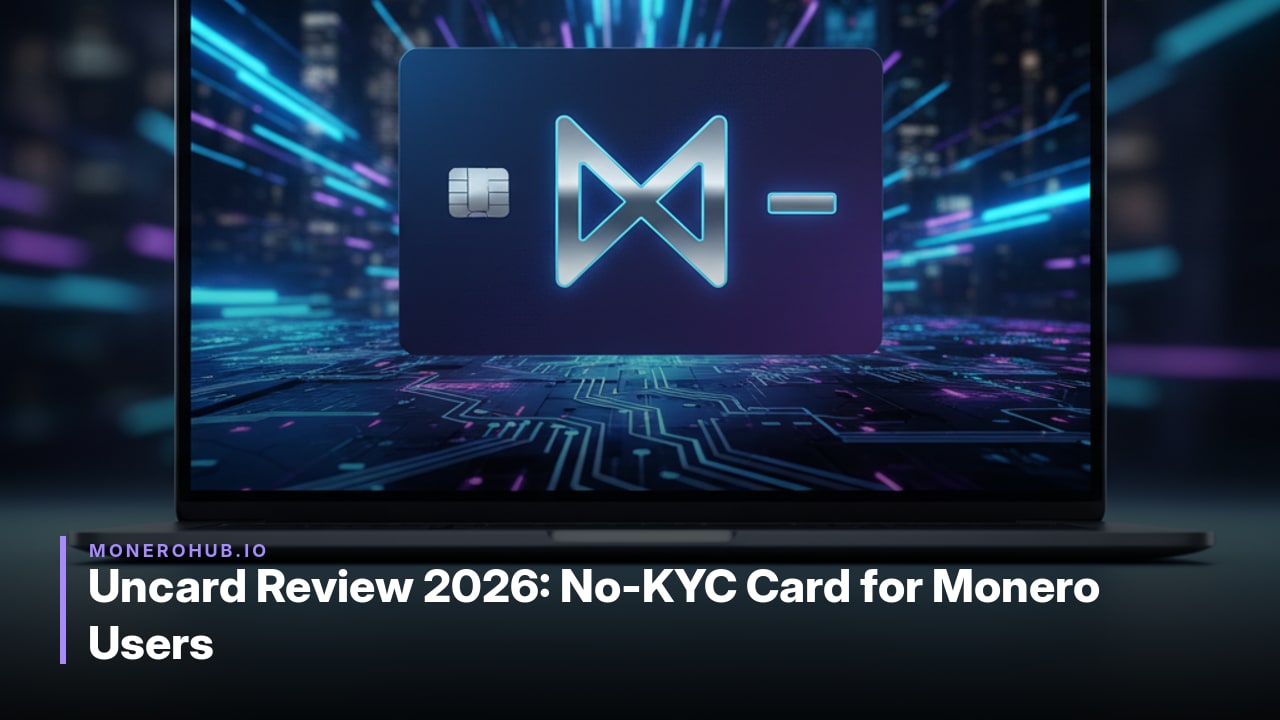
Uncard review covering its no-KYC Visa cards, Monero funding, fees, and privacy trade-offs for users seeking non-custodial spending options in 2026.
Uncard launched around April 2026 as a virtual-card service at uncard.cc that accepts Monero (XMR) deposits to fund Visa cards. The operator states it requires no identity verification and follows a no-log policy, with cards becoming active immediately after funding.
Site statistics viewed in October 2026 list more than 10,000 users worldwide, over 2,000 cards issued, and support for deposits in six or more cryptocurrencies. The same figures claim 99.9 percent uptime, an average card setup time of two minutes, and 24/7 support.
These elements place Uncard among services aimed at privacy-focused Monero users who want to avoid KYC processes common on conventional card issuers. The platform also supplies a status page and API, while community listings from October 2026 continue to include it in no-KYC virtual-card directories.
Physical cards remain listed as planned only, with no release date provided in available sources. The service first appeared in April 2026 announcements and has maintained an active site with updates through July 2026.
UnCard provides two distinct virtual card options designed for cryptocurrency-funded spending, including deposits in Monero. The Online Card includes 3D-Secure authentication and targets web-based transactions. It supports e-commerce purchases, recurring subscriptions, advertising platform payments, and travel bookings where virtual Visa credentials suffice.
The Wallet Card focuses on mobile wallet integration and works directly with Apple Pay and Google Pay. This enables contactless in-store payments and tap-to-pay functionality at physical merchants that accept those services. Both card types issue instantly once a deposit clears and function as independent instruments, allowing separate funding and usage without shared balances or linked limits.
Physical cards remain in the planning stage with no confirmed release date. Users can therefore rely on the virtual formats for immediate needs while monitoring updates for any future hardware option. These choices let Monero holders convert privacy-focused holdings into spendable Visa credentials across digital and mobile channels without additional verification steps.
Uncard lists a 4% top-up fee, $3 issuance cost per virtual card, and $0.25 per transaction with no monthly fees, according to its April–May 2026 Bitcointalk announcements. These figures remain consistent in primary operator statements viewed in October 2026, though several aggregator sites still mark all pricing as undisclosed.
| Fee Type | Uncard | Disclosure Status |
|---|---|---|
| Top-up | 4% | Confirmed April–May 2026 |
| Card issuance | From $3 | Confirmed April–May 2026 |
| Transaction | $0.25 | Confirmed April–May 2026 |
| Monthly | $0 | Confirmed April–May 2026 |
| Spend / withdrawal limits | Not published | Undisclosed as of October 2026 |
Exact per-card or monthly spend caps, FX spreads, and refund fees are absent from both the site and announcement thread. Without published limits, users cannot verify maximum load amounts or velocity restrictions before funding. The operator reports 10k+ users and 2k+ cards issued as of October 2026, yet supplies no independent verification of these volumes or fee application consistency.
Uncard states that it requires no identity verification and follows a no-log policy, a position echoed in its Bitcointalk announcements. The service appears on KYCnot.me with an April 10 2026 listing that records the operator’s no-KYC claim without independent verification.
Two operational details create clear privacy weak points. Support runs exclusively through Telegram (@uncardcc), where message metadata and account linkage remain visible to the platform. The service itself operates on clearnet infrastructure, so every visit to uncard.cc exposes the user’s IP address unless routed through Tor or a VPN.
Monero deposits reduce on-chain linkage at funding time, yet downstream activity can still create exposure. No public audits or third-party data confirm the no-log assertion, and the operator provides no transparency reports. Consequently, a subpoena, internal compromise, or simple correlation via Telegram or merchant records could identify users even when XMR is used.
Best practice therefore requires funding cards over Tor, never reusing Telegram accounts tied to other services, and treating card usage as pseudonymous rather than private. These steps limit but do not eliminate the identified risks.
Begin by sending Monero to the deposit address shown in your account dashboard. The platform credits the incoming XMR once the transaction reaches sufficient confirmations.
The operator reports an average completion time of two minutes from deposit to active card. Telegram support at @uncardcc remains available for any step that requires clarification.
Exact merchant acceptance rates remain unverified in public sources. The service issues standard Visa virtual cards, so acceptance generally follows normal Visa networks, though some merchants may flag newer or low-volume issuers.
Refund handling details are not disclosed by the operator. Users should assume refunds return to the original card balance rather than converting back to Monero automatically.
The service advertises 24/7 support through Telegram at @uncardcc. No independent response-time statistics are available beyond the operator’s claims.
Uncard states it requires no identity verification and follows a no-log policy, unlike KYC platforms that collect documents and link activity to verified identities.
The Online Card includes 3D-Secure support and is marketed for e-commerce, subscriptions, ads, and travel bookings.
The operator reports 99.9% uptime with no major outages noted in primary sources through October 2026.